 BASF, based in Germany, is one of the world's largest chemical companies - with over 350 production sites worldwide. BASF has been involved with graphene research since 2008 in collaboration with the Max Planck Institute.
In September 2023, BASF and Nanotech Energy, a developer of graphene-based energy storage products, agreed to partner to significantly reduce the CO2 footprint of Nanotech’s lithium-ion batteries for the North American market. The agreement aims to close the loop for lithium-ion batteries in North America, with BASF producing cathode active materials from recycled metals in Battle Creek, Michigan, for the usage in lithium-ion battery cells produced by Nanotech Energy. Feeding recycled metals into the production of new lithium-ion batteries can reportedly reduce the CO2 impact of batteries by about 25% compared to the use of primary metals from mines.
Contact information for BASF
Carl-Bosch-Straße 38
67056 Ludwigshafen am Rhein
Germany
Nanotech Energy to partner with BASF to enable production of lithium-ion batteries in North America with locally recycled content and low CO₂ footprint
BASF, a global battery materials producer, and Nanotech Energy, a developer of graphene-based energy storage products, have agreed to partner to significantly reduce the CO2 footprint of Nanotech’s lithium-ion batteries for the North American market. The agreement aims to close the loop for lithium-ion batteries in North America, with BASF producing cathode active materials from recycled metals in Battle Creek, Michigan, for the usage in lithium-ion battery cells produced by Nanotech Energy. Feeding recycled metals into the production of new lithium-ion batteries can reportedly reduce the CO2 impact of batteries by about 25% compared to the use of primary metals from mines.
Both companies will additionally partner with American Battery Technology Company (ABTC), a lithium-ion battery recycling company in Reno, Nevada, and TODA Advanced Materials Inc. (TODA) with decades of experience in manufacturing specialized pCAM (precursor for Cathode Active Material) and metal hydroxide material located in Ontario, Canada, to establish such a localized battery value chain for the North American consumer electronics and automotive industries. Along that chain, battery scrap and off-spec material from Nanotech’s pilot operation in Chico, California, as well as from its planned commercial facility will be recycled by ABTC. The battery-grade metals as recovered by ABTC – such as nickel, cobalt, manganese, and lithium – will be subsequently used by TODA and BASF to produce new precursors and cathode active materials, respectively. Nanotech will then use these materials again in its battery cell production – overall, a truly circular economy in North America.
Young Graphene Researchers Spotlight: Q&A with Dr. Maria Giovanna Pastore Carbone
Graphene-Info is happy to give the stage to talented young graphene researchers, especially those with such commitment and passion as Dr. Maria Giovanna Pastore Carbone, who has agreed to chat with us and answer a few questions about her background, work and collaboration with the Graphene Flagship.

Maria-Giovanna (right) in the lab at FORTH, with collaborator Christos Pavlou
Dr. Maria Giovanna Pastore Carbone is an Italian Materials Engineer, Post-Doctoral Fellow at the Institute of Chemical Engineering Sciences of the Foundation for Research and Technology Hellas (FORTH/ICEHT). She has been working on graphene since 2015 and has joined the Graphene Flagship in 2017. Her current research in the framework of the Graphene Flagship project is focused on the integration of graphene and related materials for the development of multi-functional systems (such as lightweight composites for EMI shielding applications and coatings for protection against UV-vis radiation and permeation of gasses/vapors), with emphasis on their structure/property relationship.
Haydale to lead project for high barrier monolayer films for food packaging
Haydale has announced that it has been awarded funding of £168,573 (around USD$226,250) to develop high barrier monolayer films for food packaging by Innovate UK, the UK's innovation agency.
Haydale Composite Solutions Ltd ('HCS'), will lead the consortium of nine companies - BASF, Bangor University, Cambridge Nanomaterials Technologies, Dunbia, Fre-Energy, Parkside Flexibles, Recycling Technologies, and Wells Plastics - to develop the next generation of high barrier films for food packaging using functionalized nanomaterials ("HiBarFilm2 Project"). The HiBarFilm2 Project is due to start in March 2022 and is expected to run for 30 months. It follows the success of the HiBarFilm feasibility study where functionalized nanomaterials were shown to influence barrier performance in films.
Graphene: do not miss the turning point
This is a sponsored post by IDTechEx
We have been following the graphene industry as analysts for the past seven years. The results of our ongoing research can be seen here: www.IDTechEx.com/graphene. In this time, we have seen the industry grow in maturity.
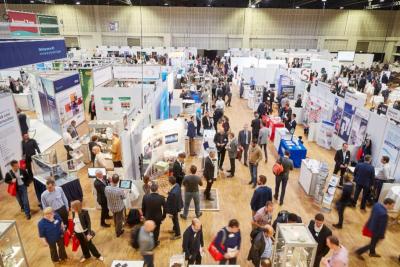
At first, the industry was an over-hyped field, full of over-promising, under-delivery, and utter confusion. Then, the community spent multiple years to covert itself into a viable proposition in multiple ways:
Dotz Nano develops a process to use graphene quantum dots for fuel authentication
 Dotz Nano has announced the successful development of a process to tag fuel derivatives with graphene quantum dots (GQDs). The technology allows GQDs to be optimally added to fuel derivatives via a patent pending method so that the GQDs cannot be easily "laundered" or "washed out" from the fuel.
The new fuel application has been said to successfully withstand various testing procedures used in international bids for fuel taggants. This was achieved by working closely with two international anti-counterfeiting/brand protection companies. Dotz Nano has also submitted a patent application on the specific tagging of fuels with GQDs.
Applied Graphene Materials partners with HMG Paints to commercialize graphene coatings
 Applied Graphene Materials has partnered with HMG Paints to develop and commercialize graphene-containing coatings for a variety of industries. Following an initial stage of controlled environment testing, which reportedly produced positive results, the two companies are now testing their product in a real world environment.
Tests will focus on the application of graphene-based coatings in both the commercial Vehicle and construction Equipment markets in partnership with a leading UK commercial vehicle body builder.
Talga enters agreement with Chemetall to develop graphene-based coatings
Talga Resources has announced the signing of a joint development agreement with Chemetall, a global business unit of BASF Coatings Division, to co-develop and commercialize graphene-enhanced metal surface coatings.
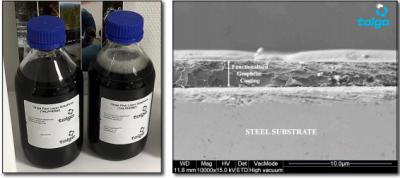
Under the terms of the Agreement, Talga and Chemetall will cooperate to develop Talga value-added graphene products for use in Chemetall surface treatment products. The joint development program aims to set new industry standards for eco-friendly, high performance, corrosion resistant surface treatments.
BASF and the National University of Singapore to jointly develop graphene for OLEDs and OPVs
 The Graphene Research Centre (GRC) at the National University of Singapore (NUS) and BASF announced a new partnership to develop the use of graphene in organic electronics devices - such as OLED devices. The goal of this collaboration is to interface graphene films with organic electronic materials, with an aim to create more efficient and flexible lighting devices.
In this collaboration, the GRC will contribute its graphene knowledge (the synthesis and characterization of the graphene) while BASF is focused on organic materials. Of course BASF is also engaged with graphene research (for several years) and are looking to speed up their device development with this new partnership.
BASF and the Max Planck Institute open their carbon material research center
BASF and the Max Planck Institute for Polymer Research (MPI-P)'s joint R&D operation, the Carbon Materials Innovation Center (CMIC) is now open at BASF’s Ludwigshafen site. The center hosts twelve chemists, physicists and material scientists and its goal is to research the scientific principles and potential applications of innovative carbonized materials by synthesizing and characterizing new materials and evaluating their potential uses in energy and electronic applications.
BASF and the MPI has been jointly researching graphene since 2008, and the new center is the next step in their collaboration, although it will research other materials as well. They have invested €10 million in this project, which is scheduled to run for three years initially.

