 The Centre for Process Innovation is a UK-based technology innovation centre. It is a non-profit institute funded by the UK government, the private sector (through contract R&D services) and matched-funding EU projects.
The CPI's open innovation model enables clients to develop products and prove processes with minimal risk. By utilizing its proven assets and expertise, companies can take their products and processes to market faster.Â
In 2014, The CPI announced the establishment of a new £14 million Graphene Applications Innovation Centre that will build on existing capabilities to provide facilities and expertise to help companies develop, prove, prototype and scale up graphene based products and processes.
Contact information for The Centre for Process Innovation (CPI)
Thomas Wright Way NETPark
Sedgefield
TS21 3FG
United Kingdom
SEEDS moves into dedicated NETPark site to scale graphene tech production
SEEDS, a UK-based deep-tech company developing engineered graphene platform technologies, is set to move into a new dedicated facility at NETPark (the North East Technology Park) as part of Durham County Council’s £100 million expansion of the site. This move marks SEEDS’ transition from a primarily R&D-focused operation to full-scale manufacturing, enabling the company to begin delivering customer-specific graphene-based systems for global industrial clients.

The new facility at NETPark will allow SEEDS to deploy its graphene and nano-structure ink technologies into real-world applications across microelectronics, energy storage, aerospace, automotive and advanced manufacturing. By moving into a purpose-built manufacturing environment, SEEDS aims to support international manufacturers with tailored production systems that can be rolled out anywhere in the world.
First Graphene reports positive results of independent study into the performance of graphene-based electrocatalysts for the generation of green hydrogen
First Graphene has announced details of an independent study into the performance of graphene-based electrocatalysts for the generation of green hydrogen. The study by the Centre for Process Innovation UK (“CPI”) showed electrodes composed of First Graphene’s metal-oxide doped graphene reduced the amount of power required to produce hydrogen from the electrolysis of water.
Analysis by the CPI has confirmed metal-oxide doped graphene materials from First Graphene can reduce overpotential, which is a measurement of energy efficiency of the electrolyser, by 43%. Improvements to the process were also identified that can increase throughput by 64%, reduce raw material costs by 50% and broaden metal oxide options in the product, providing a cost-effective commercial solution for the green hydrogen industry.
Ford Motor develops graphene-enhanced PU foam that lowers noise and weight in vehicles
At a recent conference, Ford Motor presented its innovative graphene-enhanced polyurethane (PU) foam that reduces noise in automobiles while also lowering their weight. The material was chosen as a finalist for the Polyurethane Innovation Award, given by the Center for the Polyurethanes Industry (CPI) during the conference. The foam is said to be used in all of Ford's North American vehicles.
One of the biggest challenges in developing the foam was dispersing a nanomaterial like graphene into a viscous polymer and keeping it from collapsing during mixing, said Alper Kiziltas, technical expert, sustainability and emerging materials at Ford.
New ICE-Batt project sets out to optimize battery technology using graphene and CNTs
CPI and Thomas Swan have teamed up with Johnson Matthey (JM), a company focused on sustainable technologies, to explore how to best optimize battery technology using graphene and CNTs.
The ICE-Batt project receives funding support from the Faraday Battery Challenge, managed by Innovate UK the UK’s innovation agency to enable the investigation of how innovative carbon nanotubes (CNTs) and graphene nanoplatelets (GNPs) can improve battery performance. In addition, the project will explore how to improve the green credentials of battery processing.
Thomas Swan announces graphene collaboration with Graphene Composites on protection against knife and gun-crime
 Thomas Swan announced a collaboration with nano-materials technology manufacturer Graphene Composites (GC) to provide the graphene solution in their GC Shield Armour products.
It was stated that the product is the result of a lengthy development collaboration between the companies together with the Centre for Process Innovation (CPI) using GNP-M grade graphene from Thomas Swan in the final application - an endorsement of the company’s ability to manufacture graphene in volume.
CPI, Haydale and others collaborate on Smart Filter project
The Centre for Process Innovation (CPI) has collaborated on a project to advance the development of a low-cost, self-cleaning coating technology for industrial filter membranes.
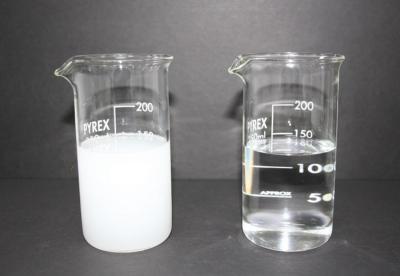
The Smart Filter project used graphene and its derivatives to create a coated filter membrane that offers increased resistance to fouling for industrial waste water treatment. Membrane filters are used in a number of industrial separation applications but are afflicted by fouling, which typically lowers throughput or increases energy consumption, and reduces filter life. Focusing upon oil water separation and nuclear waste water treatment, the collaboration, with G2O Water Technologies, Haydale and Sellafield, developed a repeatable, reproducible and scalable process to make coated filter membranes, which delivered a 30% improvement in permeability when compared to an equivalent uncoated filter.
CPI and NCC to jointly develop next-gen graphene-based materials
The Center for Process Innovation (CPI) will be collaborating with the National Composites Center (NCC) to develop advanced lightweight materials. The project, known as ‘Enhanced structural composites’ (ECOi), is evaluating the functionality and applicability of new graphene-enhanced materials in a variety of industries.
The University of Manchester will be consulting on the ECOi project at their National Graphene Institute, to generate and test a variety of new graphene composites that have improved functional properties compared to current materials.
Two projects demonstrate how metal-oxide coatings influence graphene
Two interesting projects focused on coating single-layer graphene with metal-oxide nanolayers were presented at the latest Thin Films and Coating Technologies for Science and Industry event in the UK. Researchers from Cranfield University, UK, together with collaborators from University of Cambridge and the Centre for Process Innovation (CPI), applied alumina to form a composite barrier layer, while a team from Imperial College London, UK, used the unique properties of strontium titanate to fabricate a tuneable capacitor.
The researchers of the first project explained that in theory, graphene should represent an ideal ultrathin barrier layer, as the pores between carbon atoms are smaller even than the radius of a helium atom. In practice, however, crystal boundaries and missing atoms allow vapor to permeate through the material, and the weak van der Waals bonds between planes mean that even stacks of multiple graphene layers can be penetrated. The solution reported by the team is to take a graphene monolayer formed by CVD, and to then use atomic layer deposition (ALD) to coat it with a 2550 nm thick layer of alumina. Achieving conformal coatings on single-layer graphene is known to be difficult due to the material’s strong hydrophobicity.
UK researchers demonstrate a viable graphene-based OLED encapsulation solution
OLED displays are very sensitive to oxygen and moisture, and the need to protect the displays is one of the major challenges of this next-generation display technology. First generation OLED displays were protected with a glass barrier, but glass is not easily flexible and so cannot be used in flexible OLEDs. Flexible OLEDs are today encapsulation with a thin-film encapsulation layer made from both organic and in-organic materials, and companies are searching for better OLED encapsulation technologies.
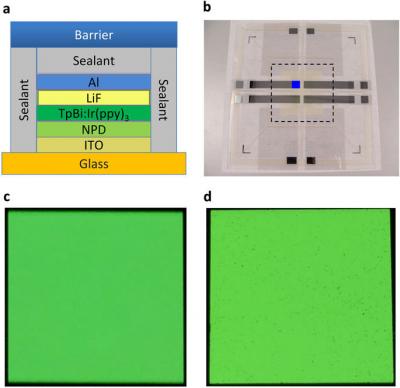
Graphene is the world's most impermeable material, and so the idea of using graphene as a barrier layer for OLED has been around for a while. In 2015 the UK launched a collaboration project called Gravia to develop graphene-based encapsulation, and the project's team has now reported their results.
Versarien to supply graphene to the CPI
 The advanced materials engineering group Versarien announced that it has won a tender for the ongoing supply of nanomaterials to the Centre for Process Innovation. Versarien will supply up to 1.2 kilograms of graphene in a variety of forms to the CPI, in addition to hexagonal layer boron nitride.
Neill Ricketts, chief executive of Versarien, said: "We are very pleased to have been successful in all the tenders we entered into to supply the CPI with our nanomaterials after a competitive process". "For Versarien this is an important route for the commercialization of products enhanced by graphene and other related materials", "We continue to receive record levels of enquires from potential purchasers of our products globally and look forward to making further announcements as appropriate," Ricketts said.

