 FlexEnable develops OTFT-based backplanes for flexible displays, suitable for both EPD and OLED technologies. The company was spun-off from Plastic Logic in February 2015 to further develop the technology and license it for display makers.
FlexEnable has a track record of groundbreaking graphene innovation and industrialisation. Last year the company successfully demonstrated a truly flexible display based on a transparent graphene conductor, which was integrated into its flexible transistor array.
Contact information for FlexEnable
34 Cambridge Science Park
Cambridge
CB4 0FX
United Kingdom
UK researchers demonstrate a viable graphene-based OLED encapsulation solution
OLED displays are very sensitive to oxygen and moisture, and the need to protect the displays is one of the major challenges of this next-generation display technology. First generation OLED displays were protected with a glass barrier, but glass is not easily flexible and so cannot be used in flexible OLEDs. Flexible OLEDs are today encapsulation with a thin-film encapsulation layer made from both organic and in-organic materials, and companies are searching for better OLED encapsulation technologies.
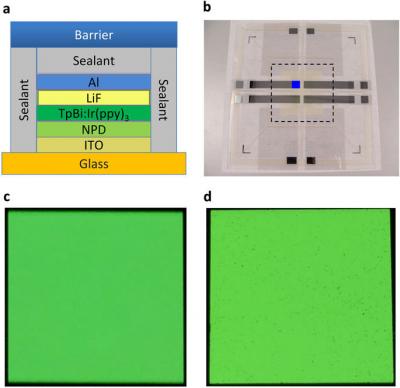
Graphene is the world's most impermeable material, and so the idea of using graphene as a barrier layer for OLED has been around for a while. In 2015 the UK launched a collaboration project called Gravia to develop graphene-based encapsulation, and the project's team has now reported their results.
Will Samsung incorporate graphene electrodes in their upcoming OLED TVs?
The OLED Association, a trade group that promotes OLED technologies, published an interesting article in which they give predictions for the OLED market. The Association sees Samsung returning to the OLED TV market in 2017, and those upcoming OLED TVs will use several new technologies - including graphene-based transparent electrodes.

Last month we reported that researchers at Korea's ETRI developed transparent graphene-based electrodes for OLED panels. The researchers say that these new electrodes improve the transparency and "image quality" of OLEDs by 40 to 60 percent, compared to current silver-based electrodes. The researchers aim to continue the research and improve the performance of their electrodes.
New transparent graphene-based electrode to improve the transparency and quality of OLED displays
Researchers at Korea's ETRI (Electronics and Telecommunications Research Institute) developed transparent graphene-based electrodes for OLED panels. The researchers say that these new electrodes improve the transparency and "image quality" of OLEDs by 40 to 60 percent, compared to current silver-based electrodes.
The researchers explain that current metal (mostly silver) based electrodes have a limited viewing angle because of their internal light reflection, and the external light reflection affects the image quality. Graphene electrodes are more transparent and reduce the reflectance by 40-60 percent.
Graphene-Info's impressions from the birthplace of graphene
In early November, the graphene-info team visited the UK - the birthplace of graphene. Our first stop was Cambridge - visiting FlexEnable and Cambridge Nanosystems - and then we headed for the Cambridge Graphene Center for a two-day graphene conference. We finished the tour with a trip up north to Manchester, to see the NGI, Manchester University's Graphene institute.

While we try to be on top of everything that is related to graphene, our first impression from the visits and the conference is that the graphene industry is much more active than it seemed. There are many very exciting projects, some on the verge of commercialization, and it looks like graphene is going to make a larger impact than we expected in the near future. We came back very encouraged!
UK collaboration seeks to develop graphene-based ultra-barrier materials for displays and electronics
 The Centre of Process Innovation (CPI) has announced that it will be part of a UK-based collaboration to develop the next generation of graphene-based ultra-barrier materials for flexible transparent plastic electronic based displays. The materials on which this work focuses on are required for the next generation of smartphones, tablets and wearable electronics and the twelve month project titled ‘Gravia’ will investigate the feasibility of producing graphene-based barrier films for next generation flexible OLED lighting and display products.
The project combines the skills from each of the partners (University of Cambridge, FlexEnable Ltd, the National Physical Laboratory and the Centre for Process Innovation) and expects to deliver a feasible material and process system. It builds upon significant existing investments by InnovateUK and the EPSRC in this area. The resulting ultra-barrier material can be potentially used in a wide range of novel applications by the lead business partner, FlexEnable.
FlexEnable details their graphene OTFT goals
UK-based FlexEnable was spun-off from Plastic Logic in February 2015 with an aim to further develop and commercialize the company’s technology platform for organic thin film transistor (OTFT) arrays for flexible displays and ubiquitous sensing. Last month FlexEnable joined the graphene flagship, and announced plans to develop new use cases for graphene in flexible electronics.
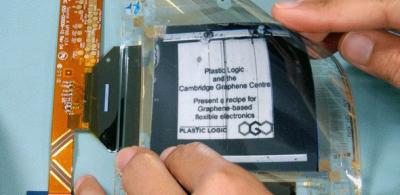
I talked briefly to Mike Banach, FlexEnable's Technical Director, and he explained the company's graphene plans and goals. FlexEnable is not a material company - they do not aim to develop and produce graphene material. The define themselves as a applied process technology - what we call a graphene application developer, focused on the flexible electronics market.
FlexEnable joins the Graphene Flagship and details its graphene plans
 UK-based FlexEnable has recently joined the Graphene Flagship and announced its plans for this year, which will mainly focus on developing new use cases for graphene in flexible electronics including highly conductive interconnect lines and barrier films.
Starting April 2016, the Graphene Flagship is scheduled to move into its core project phase, where FlexEnable’s expertise in industrializing flexible electronics will be utilized to harness the potential of graphene and other 2d materials. FlexEnable’s Cambridge fab will play an important role in showcasing graphene’s performance over surfaces of all sizes, including large areas as well as in the development of advanced product concepts.

