NanoGraphene and Solar Quartz Technologies to work together on graphene-enhanced solar products
 NanoGraphene has teamed up with Solar Quartz to develop graphene-enhanced solar industry products and new applications. The two companies aim to enhance the generating potential of solar panels to above 40%.
The partners plan to utilize their extensive experience and knowledge of high purity quartz and solar-grade silicon production industries together to develop new graphene-enhanced solar grade materials, applications and products with remarkable new attributes.


Thin graphene film quickly warms up to super high temperatures
A collaboration between three Australian universities has produced a new graphene metamaterial that could be used in solar heating. The ultrathin film also has potential to be used in desalination, for displays, or even as cloaking technology.

Swinburne University of Technology’s Professor Baohua Jia, who led the research, points to a few features that make the material so innovative: The absorption is coming from the sun and then converted to heat, she said, So, basically, there is no external energy or electricity required. The film heats up to 160 degrees Celsius under natural sunlight within one minute.
Verditek raises over $730,000 for solar cell commercialization
Verditek, developer of lightweight solar panels along with Paragraf, a Cambridge-based graphene technology developer, announced that it has raised GBP 600,000 (around USD 739,500/EUR 676,400) in a share placing to speed up its growth plans, replenish working capital and fund a silicon/graphene solar project.
The company said it will use the raised funds to speed up its growth plans as it moves to commercialization, provide working capital for its Italian solar factory, which can currently produce 20 MW of modules per year, and cover its 50% share of the joint development programme with Paragraf, under which the two are working on a silicon/graphene integrated solar cell.
Korean scientists develop graphene electrode to enable next-gen perovskite solar cells
Several research institutions in South Korea are actively conducting research and development on next-generation solar cells, heightening expectations for commercialization. The research team led by Prof. Yoon Soon-gil of Chungnam National University has developed a new graphene electrode to produce perovskite solar cells at a low temperature. In addition, the team led by Prof. Choi Kyoung-jin of the School of Materials Science and Engineering at UNIST has developed a new concept tandem solar cell using transparent conductive adhesives (TCA).
The graphene electrode developed by Professor Yoon’s team can help create a perovskite solar cell at a low temperature and can raise both safety and economic efficiency.
Elcora enters R&D agreement with Solargise Canada for graphene-enhanced solar technology
 Elcora Advanced Materials has announced it has entered into a research and development agreement with Solargise Canada, a solar manufacturing and utility-scale power project development company.
The scope of work of the research and development agreement includes the development of new technologies using graphite and graphene to improve and augment the efficiency of the solar photovoltaic panels manufactured by Solargise.
Verditek and Paragraf shooting for high efficiency silicon/graphene solar cells
Verditek and Paragraf have announced that they have successfully applied graphene to a photovoltaic (PV) cell as part of a joint development program (JDR) and are now continuing work with the goal of surpassing 25% efficiency.
London-based clean technology company Verditek explains that as part of the partners’ first development project they applied Paragraf's graphene manufacturing process to Verditek's solar technology to produce a working proof-of-concept silicon/graphene integrated solar cell. As a next-stage project, they will aim to boost the performance of the cells, develop the opportunity to file patents and possibly initiate commercial discussions for industrial manufacture and application.
ZNShine to supply graphene-enhanced solar modules to the UAE
Znshine Solar, a Chinese solar module manufacturer, has announced signing a 100MW graphene-enhanced solar module supply agreement with UAE's Etihad Energy services as a result of Znshine's participation in the tender launched by DEWA (Dubai Electricity and Water Authority) in January.
CEO of Etihad Energy Services, Mr. Ali Mohammed Al Jassim, explained that the modules will be used in various projects as part of Shams Dubai, the leading initiative that supports the vision of the government to make Dubai one of the most sustainable cities in the world; it also supports diversifying the energy mix by promoting the use of clean and renewable energy sources to build a sustainable future for the Emirate.
Graphene inks help stabilize the stability of perovskite solar cells
Researchers from the Graphene Flagship have developed hybrids of graphene and molybdenum disulphide quantum dots to stabilize perovskite solar cells (PSCs). PSCs are a novel type of solar cells which are efficient, relatively easy to produce, made with cheaper materials and, due to their flexibility, can be used in locations where traditional silicon solar cells cannot be placed.
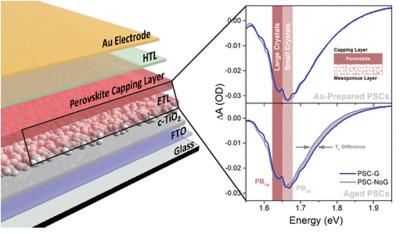
A collaboration between the Graphene Flagship Partners Istituto Italiano di Technologia, University of Rome Tor Vergata, and BeDimensional resulted in a novel approach based on graphene and related materials to stabilize PSCs, thus addressing the stability issue of PSCs, a major hurdle hindering their commercialization.
The Graphene Flagship announces its 2019-2030 graphene application roadmap
The EU Graphene Flagship has published its graphene application roadmap, showing when the flagship expects different graphene applications to mature and enter the market.
 As can be seen in the roadmap above (click here for a larger image), the first applications that are being commercialized now are applications such as composite functional coatings, graphene batteries, low-cost printable electronics (based on graphene inks), photodetectors and biosensors.
Novel graphene film offers new concept for solar energy
Researchers at Swinburne, the University of Sydney and Australian National University have collaborated to develop a solar absorbing, ultra-thin graphene-based film with unique properties that has great potential for use in solar thermal energy harvesting.
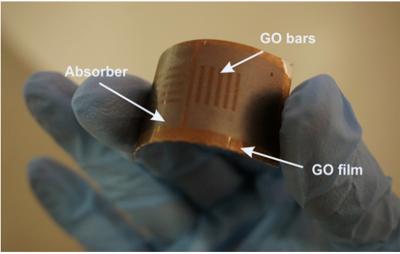
The 90 nanometre material is said to be a 1000 times finer than a human hair and is able to rapidly heat up to 160°C under natural sunlight in an open environment.

